Context
AI developer intelligence. Engineering teams lose context across docs, runbooks, agent sessions, and system behavior. AI coding tools move fast, but the knowledge layer behind them stays fragmented—so agents repeat mistakes and engineers rebuild the same answers.
Dexicon needed a market-facing story that made that gap legible: why a knowledge context layer matters, and how it connects the tools teams already use without becoming another silo.
Problem
Dexicon needed to make a new developer-intelligence category legible in a noisy market of AI coding assistants and internal knowledge tools.
What NextGrid Did
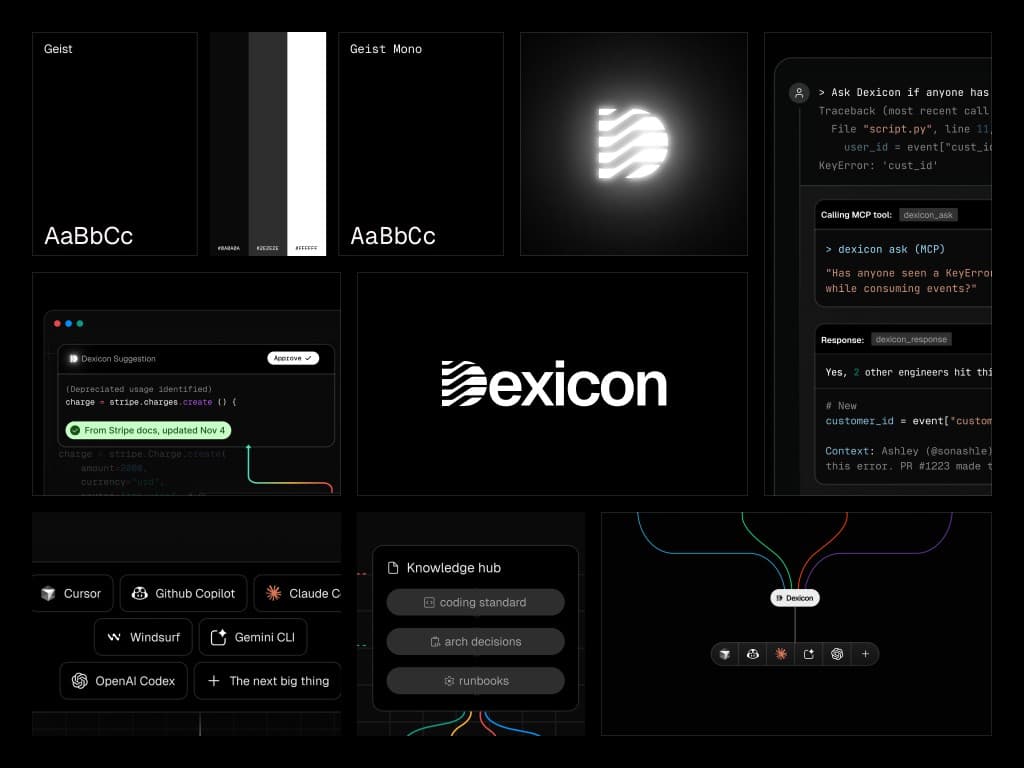
NextGrid shaped the brand and story around shared engineering context for AI coding workflows, docs, decisions, and agent sessions.
System Designed
Category positioning, brand system, website narrative, and developer-product storytelling formed the strategic foundation.
The narrative was anchored on developer intelligence as infrastructure—unifying coding standards, architecture decisions, and operational signals into context agents can actually use. The brand system and digital experience were built around clarity and technical credibility: typography, color, and UI patterns that feel native to engineering teams evaluating serious AI workflow tools.
Outcome / Signal
Dexicon launched with a sharper story that positions the product as context infrastructure rather than another chatbot wrapper.
Why It Mattered
Technical buyers need to understand what layer the product occupies and why it connects to existing workflows instead of adding another silo.
What This Taught Us
An AI product avoids wrapper perception by showing durable workflow value beyond the model call. That means explaining proprietary context, system behavior, integration depth, review loops, or operational knowledge that makes the product hard to replace. Dexicon's story focused on connecting engineering knowledge across docs, decisions, and agent sessions—positioning the company around infrastructure and context, not a thin interface.
Developer-tool positioning also benefits from naming the workflow layer the product improves rather than repeating generic AI language. Technical buyers are skeptical of broad assistant claims, so the story needs to show where the product fits into docs, code, standards, decisions, and team behavior. That specificity is what makes the category feel real rather than aspirational.
Questions
How do you position an AI developer-tool startup?
Start by naming the workflow layer the product improves, not by repeating generic AI language. Developer-tool buyers are skeptical of broad assistant claims, so the story needs to show where the product fits into docs, code, standards, decisions, and team behavior. For Dexicon, the sharper frame was shared engineering context for AI coding workflows. That made the product feel like infrastructure that agents and teams can use, not another chatbot.
What should a technical startup website explain first?
A technical startup website should explain the system problem, the product's role in the stack, and why the buyer should trust the approach. Feature depth matters, but only after the visitor understands where the tool fits. Dexicon needed to explain how fragmented engineering knowledge affects AI coding workflows and why a context layer matters. That gave technical buyers a clearer path into the product before evaluating integrations or architecture.
How can an AI product avoid sounding like a wrapper?
An AI product avoids wrapper language by showing durable workflow value beyond the model call. That means explaining proprietary context, system behavior, integration depth, review loops, or operational knowledge that makes the product hard to replace. For Dexicon, the story focused on connecting engineering knowledge across docs, decisions, and agent sessions. That positioned the company around infrastructure and context, not a thin interface over a generic assistant.