Turning relationship data into enterprise pipeline intelligence
Enterprise sales teams spend enormous amounts of time trying to manufacture access: cold email, outbound sequences, LinkedIn messages, events, account lists, more enrichment, more intent data, more automation. And still, some of the highest-value deals move because somebody already knows somebody. That was the opportunity behind Vieu.
Vieu was building a platform around relationship intelligence: mapping the extended network around a company, identifying the strongest paths into target accounts, and helping revenue teams turn trusted connections into qualified pipeline. When we started working with them in 2024, the product already had depth. The challenge was making that depth understandable. The company needed to communicate something larger than “we help you get warm introductions.” It needed to feel like a serious enterprise revenue-intelligence platform built around trust, strategic access, and the network a company already owns.
The problem wasn't more outbound
Enterprise GTM has become very good at producing activity. Teams can buy lists, enrich contacts, generate personalized emails, automate sequences, score intent, and track engagement. The result is often simply more companies sending more messages to the same buyers.
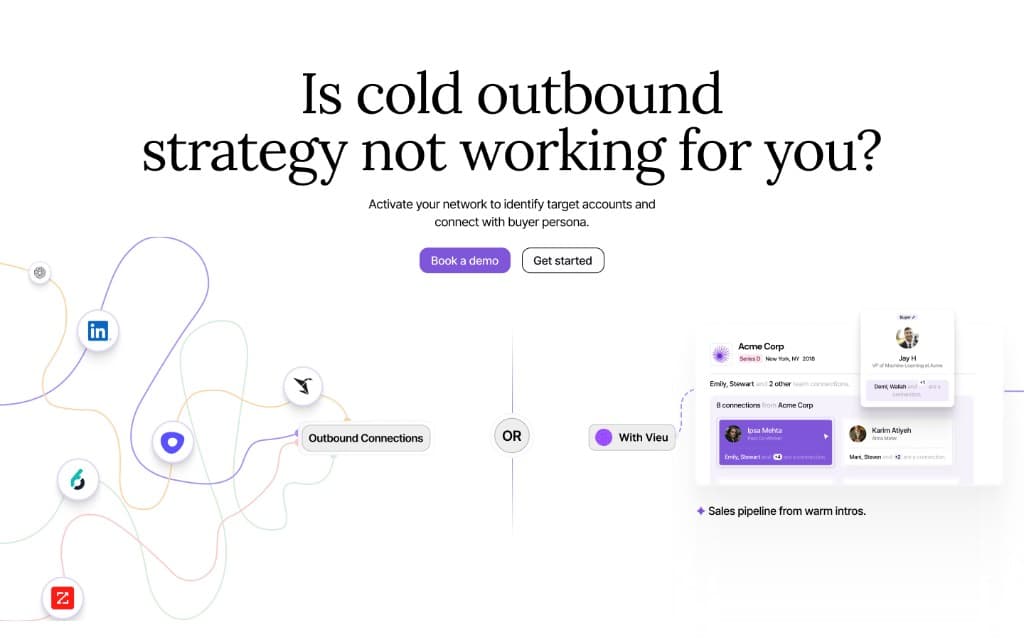
Vieu started from a different premise: the strongest path into an account may already exist inside your network. An investor might know the buyer. A customer could know someone on the executive team. An employee may have worked with the account before. A board member might be connected to the founder. A partner might already have credibility inside the organization. Those relationships exist. Most companies just cannot see them as infrastructure. That became the central idea we wanted the website to communicate.
The graph made the invisible visible
A company can have hundreds or thousands of valuable relationships spread across employees, executives, investors, advisors, customers, partners, board members, former colleagues, and professional networks. Those relationships usually live inside individual memory. Someone knows someone. Another person does not know that they know them. A salesperson discovers the connection three months after sending thirty cold emails. The business owns the network in theory. It does not have a system for using it.
Vieu’s product maps relationships across the extended network around an organization and turns that into a graph — not only that person A knows person B, but who knows the account, how strong the relationship is, what the most credible route in is, which decision-makers are reachable, who can introduce whom, and which accounts are closer than the sales team realizes. Once relationships become structured data, they can become part of revenue strategy. Relationships stop being anecdotes and become intelligence. That was the conceptual leap the website needed to explain.
Position Vieu beyond a sales tool
This was probably the most important strategic decision in the work. It would have been easy to frame Vieu as another prospecting product: find the account, find the connection, request an introduction, done. The underlying capability had much broader implications. The same relationship graph could support new customer acquisition, target-account planning, strategic proposals, executive engagement, partnerships, customer expansion, renewals, fundraising, hiring, and ecosystem development.
Vieu was not only helping salespeople send a warmer message. It was helping organizations understand who they could reach through trust. The positioning needed to elevate the product from an outbound feature into something closer to enterprise relationship infrastructure.
We designed around access, not activity
Before designing pages, we focused on the sequence a buyer needed to understand. The problem was not a shortage of contact data. The market already had plenty of that. The deeper problem was: we know who we want to reach; we do not know the strongest way to reach them. From there the story could move through the target account, the hidden relationship network, reachability, a warm introduction path, strategic account intelligence, and commercial opportunity. Instead of presenting the graph as technically impressive, we wanted to show what the graph could actually change.
The answer to weak outbound is not always better outbound. Sometimes the company already possesses an unfair advantage — its network — and the problem is that the network is not visible enough to use systematically. That changed the website language. Instead of selling Vieu as another tool that helped teams contact more people, we positioned it around helping teams activate relationships they already had. That was more credible, and more defensible, because trust does not scale the way commodity contact data does.
The visual system needed to make the relationship graph understandable without turning the site into a network-science presentation. A buyer does not care that a graph has a certain number of nodes. They care that this person can get them into that account. So we emphasized warm introduction paths, relationship-graph intelligence, target-account reachability, strategic account planning, and executive-based marketing. The technical object was the graph. The business object was access.
The experience had to feel enterprise
Relationship products can easily feel lightweight: networking, introductions, contacts, social graphs. Vieu was selling into serious revenue teams. The website needed enough intelligence and authority that a CRO, VP Sales, RevOps leader, or enterprise GTM executive could see it as infrastructure rather than a networking utility. We worked across website narrative, content architecture, visual identity, interaction design, product storytelling, motion, enterprise positioning, and digital assets. The objective was a high-trust experience that made the product feel as sophisticated as the decisions it was designed to influence.
Vieu was also a good fit for motion. Relationships are not static: a target account sits somewhere in the network, paths emerge, connections become visible, one relationship leads to another. That behavior is difficult to communicate through static screenshots. We used LottieLab alongside Figma and Webflow so parts of the experience could show network, path, and access quickly. The purpose was not decorative animation. The relationship graph needed to feel alive because the product itself was about navigating a living network.
Once the narrative and visual system were established, we implemented the digital experience in Webflow so the Vieu team could evolve the site alongside positioning, campaigns, and new product use cases without engineering involvement for every change. The surface layer was the deliverable. The intent was larger: make a technically complex graph product commercially legible.
The company kept expanding the idea
The work happened between August and October 2024. A few weeks later, in October 2024, Vieu announced an $11 million funding round. Publicly, the company said its customer and revenue counts had more than tripled over the preceding twelve months. We would not claim our website created that result. It did not. Vieu had built the product, customers, and commercial momentum behind that round. The timing is still relevant: we worked with the company while its product and market ambition were expanding quickly, and the digital presence needed to communicate that next version of the business.
Since then, Vieu has continued broadening the idea well beyond traditional sales prospecting. Its current positioning has moved toward what it calls the World’s Business Graph. Instead of relationship intelligence being useful only to Sales, the graph can support Sales, Marketing, Customer Success, Partnerships, Fundraising, and Talent and HR. Once an organization can map its extended network and understand the relationships surrounding companies and people, the graph becomes useful anywhere access, trust, and context affect an outcome. What began as a better way to reach enterprise buyers starts looking more like an organizational data layer.
By 2026, public reporting described Vieu as having grown to around 40 employees and more than 100 enterprise customers. Those are Vieu’s achievements, not ours. They matter because they show where the company went after the period we worked together: the product continued evolving toward a broader category, the relationship graph became a larger business graph, and the commercial proposition expanded accordingly.
Don't sell the feature. Find the infrastructure underneath it.
At first glance, warm introductions sound like a feature: click an account, find someone who knows them, ask for an intro. Useful, but not necessarily a category. The interesting work began when we looked underneath that feature. Vieu could find the introduction because it understood relationships. When enough relationships become structured, you create a graph. When that graph spans employees, executives, investors, customers, and partners, you create an organizational asset. When that asset can help teams understand who they can reach, you have something much larger than outbound. Warm introductions were the use case. Relationship intelligence was the product. The network was the asset.
Vieu is a useful reminder that positioning often changes when you stop describing what the software does and start asking what new capability it gives the company. Vieu did not simply make cold outreach warmer. It gave organizations visibility into something they already possessed but could not systematically use: trust. Our role was to take that idea and make it easier to understand, believe, and buy. The graph belonged to Vieu. The relationships belonged to its customers. We worked on the layer between them and the market — turning an invisible network into a visible commercial advantage.