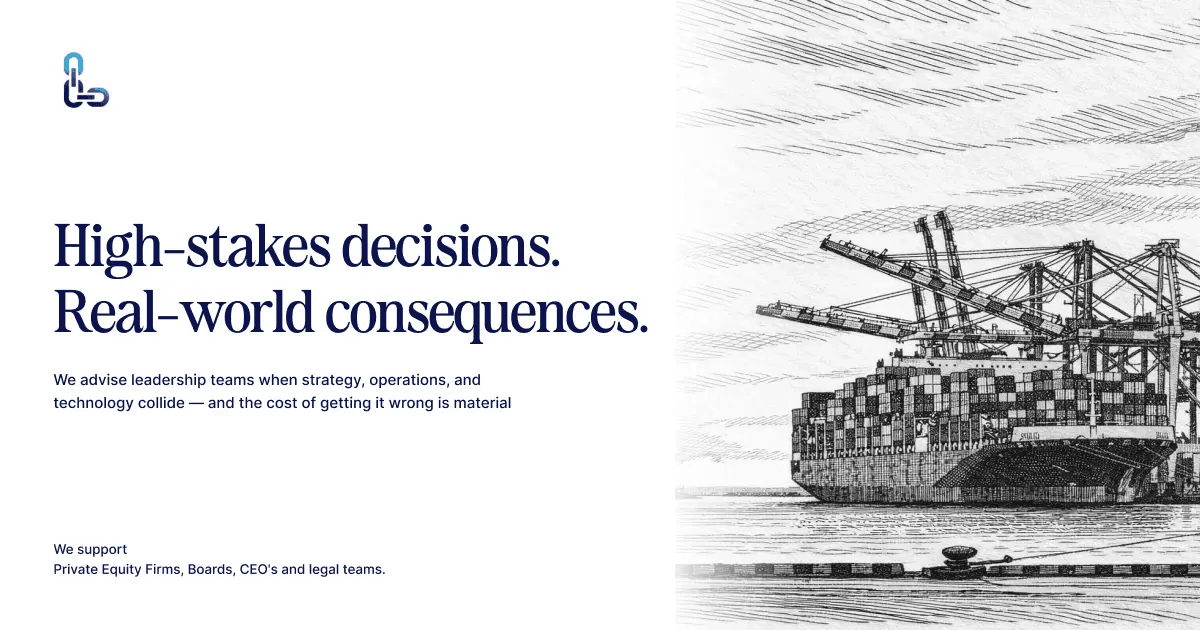
High-stakes decisions. Real-world consequences.
Logical Digital Solutions advises leadership teams when strategy, operations, and technology collide, and the cost of getting it wrong is material. Its clients and audiences are not looking for another generic transformation consultancy. They include private equity firms, boards, CEOs, and legal teams dealing with decisions where operational reality matters.
Behind LDS is Andrew Scott, an operator with decades of experience across logistics, supply chains, technology, and infrastructure. We already knew Andrew through our work with QuayChain. When he brought us into Logical Digital Solutions, the challenge was different. We needed to take decades of operating knowledge and position it for the people who need that experience when the stakes are highest.

Three different problems. One underlying advantage.
Logical Digital Solutions operates across three primary areas. Litigation Support: expert analysis and testimony for commercial and operational disputes. Industry Advisory: strategic guidance for trucking, 3PLs, freight forwarding, and supply-chain operators. Technology & AI Guidance: objective evaluation of systems, automation, and technology investments.
At first, these can look like three unrelated businesses. They are not. The connective tissue is operating judgment. Whether Andrew is advising a CEO, helping an investor evaluate an opportunity, assessing a technology investment, or supporting a legal team, the underlying question is similar: does what we are being told make sense in the real world? That became the foundation for how we approached the company.
The credibility already existed
This was not a situation where we needed to manufacture a point of view. Andrew had spent decades inside the industry. He had built companies. Worked across logistics operations. Worked around ports and infrastructure. Evaluated and deployed technology. Seen systems succeed. Seen systems fail. Worked with companies trying to modernize complicated physical operations.
The raw material was already there. Our job was to make that experience easier for the right audience to understand and buy.
Industry Advisory
One part of LDS focuses directly on the industry Andrew knows deeply. Trucking. 3PLs. Freight forwarding. Supply-chain operations. These are businesses where problems rarely exist neatly inside one department. A technology decision can become an operational problem. An operational problem can become a customer problem. A customer problem can become a margin problem. And eventually someone is asked to fix the symptoms without understanding what created them.
The LDS proposition needed to communicate that Andrew could work across those boundaries. Not from the perspective of someone who had studied the industry from outside. From the perspective of someone who had operated inside it. That distinction became central to the positioning.
Technology & AI Guidance
This became particularly important as AI entered almost every executive conversation. Companies are under enormous pressure to automate, add AI, modernize systems, replace legacy infrastructure, and buy new software. The technology industry naturally frames those decisions around capability: what can this technology do?
LDS approaches the decision from another direction: should we actually do it? What problem are we solving? Does the technology fit the operation? What has to change around it? What will implementation really require? What are the economics? Where are the dependencies? What happens if the assumptions are wrong?
The website describes this deliberately as objective evaluation of systems, automation, and technology investments. That word, objective, matters. LDS is not there to sell the software. The value is helping leadership decide whether the software deserves to be bought in the first place.
Litigation Support
Litigation creates a different version of the same problem. A dispute might involve contracts, documents, and competing accounts of what happened. But when the dispute involves logistics or operations, understanding the paperwork is not always enough. Someone needs to understand the physical system underneath it. How should this operation normally work? Who controls which part? What would an experienced operator reasonably expect? Was a particular outcome foreseeable? Does a technical explanation make operational sense? Where could the failure have originated?
Logical Digital Solutions provides expert analysis and testimony for commercial and operational disputes. The positioning needed to communicate something difficult: Andrew is not valuable to a legal team because he understands legal language. He is valuable because he understands the operational reality the legal argument is about.
Private equity created another important audience
LDS also supports private equity firms. That introduces another high-stakes decision: should we put capital behind this? Financial diligence can tell an investor a great deal about a company. A spreadsheet does not necessarily tell you whether an operational assumption makes sense.
A logistics technology company might project enormous efficiency gains. A management team might claim a workflow can scale. A new system might promise substantial automation. The numbers can work beautifully while the operational assumptions underneath them are fragile. This is where someone with decades of industry experience can ask different questions. Does the workflow make sense? Can this technology actually be deployed? Does the customer behave the way management assumes? Are the projected improvements realistic? Where could implementation break? What would an operator question that a financial model might not?
LDS could bring operational diligence into an investment conversation.
Boards and CEOs have a different version of the same problem
For boards and CEOs, the question often is not can we do this? It is should we do this? Should we automate this workflow? Should we replace this system? Should we make this acquisition? Should we invest in this technology? Should we change how this operation works? And what happens if we are wrong?
That is why we kept coming back to one line: High-stakes decisions. Real-world consequences. It was not simply a headline. It described the category of problem LDS wanted to own.
We rebuilt the company around the decision, not the service list
Once that became clear, we could rethink the digital presence. The website did not need to make LDS appear bigger. It needed to make the company clearer. We worked on the positioning, narrative, structure, visual direction, design, and development around the audiences Andrew wanted to serve.
The visual language deliberately moved away from generic consulting imagery. We wanted something that could comfortably sit in a conversation involving private equity, a CEO, a board, a legal team, a trucking operator, an infrastructure company, or an executive trying to decide whether an AI investment actually makes sense. The company needed to feel institutional without becoming sterile. Technical without looking like a software vendor. Experienced without feeling dated. And specialized without trapping Andrew inside one narrow service.

The actual problem
The work included positioning and narrative, website strategy, information architecture, website design, Webflow development and migration, a visual system, Industry Advisory positioning, Litigation Support positioning, Technology & AI Guidance positioning, private equity and executive audience strategy, translating Andrew’s operating experience into commercial narratives, and structuring complex expertise into a much simpler digital experience.
Those were the outputs. The actual problem was harder: how do you take decades of experience that exists inside one person’s head and turn it into a company another executive immediately understands?
This was not our first project with Andrew
That is also an important part of this story. We originally started working together through QuayChain. There, we worked on repositioning an eight-year-old logistics technology company and built intelligence infrastructure around Andrew’s changing interests across logistics, technology, investment, and litigation.
That work gave us context. We learned more about Andrew. We learned his industry. We understood how he evaluated technology. We understood where his experience was unusually valuable. So when Logical Digital Solutions came into the picture, we were not beginning with a discovery questionnaire and an empty Figma file. We already had context. Andrew trusted us with another company. And we could start much further ahead.
What LDS represents
Logical Digital Solutions reinforced something important about how we want NextGrid to work. Sometimes the client does not need more ideas. They already have thirty years of them. They do not need another framework. They have operating experience that no framework can manufacture. The opportunity is to understand what has accumulated inside the business, identify which parts are commercially valuable now, and build the positioning and infrastructure required to take that knowledge somewhere new.
With LDS, the answer became increasingly clear. Andrew’s value was not simply logistics expertise. It was the ability to bring real operating judgment into decisions where strategy, operations, and technology collide. Private equity can use that. Boards can use that. CEOs can use that. Legal teams can use that. And increasingly, companies trying to understand what AI and automation actually mean for their operations can use it too.
We did not invent that expertise. We helped make it legible.
Questions
Was Logical Digital Solutions a new-logo project?
No. We already knew Andrew Scott through QuayChain. That context travelled. When LDS came in, we were not starting from a discovery questionnaire and an empty Figma file.
What did you actually make legible?
Decades of operating judgment for private equity, boards, CEOs, and legal teams. The expertise already existed. The company needed to be understandable in rooms where the cost of getting it wrong is material.